Executive summary
Decentralized exchanges (DEXs) are trading venues built on blockchain networks where users swap assets directly from self-custodied wallets and settle transactions on-chain or on rollups that periodically finalize to a base chain. In practice, the DEX category now includes multiple market designs: automated market makers (AMMs), on-chain order books, hybrid off-chain matching engines with on-chain settlement, and app-chain or L2-first venues.
From an operator and participant perspective, DEXs matter because they combine non-custodial access, programmable settlement, and composable liquidity. They can reduce dependence on a single intermediary while enabling faster market-structure innovation. At the same time, DEXs introduce distinct risk surfaces: smart-contract logic failures, oracle manipulation, MEV externalities, bridge trust assumptions, and governance capture.
Data timestamp note: this report uses publicly visible snapshots. As of Feb 12, 2026, DeFiLlama indicates approximately $9.558B spot DEX volume (24h) and $378.685B spot DEX volume (30d). The DEX-protocol category view shows approximately $13.087B TVL, $89.767B volume (7d), $62.88M fees (7d), and $10.84M revenue (7d).
Assumptions and data gaps (high impact)
Comparable, protocol-agnostic liquidity-depth metrics are not consistently published across DEXs. Because of that, this article uses TVL, rolling volume, fees, revenue, and protocol-level design properties as primary comparables. Where deep microstructure data is missing, the gap is explicitly noted.
DEX basics and core technical concepts
AMMs, CFMMs, and liquidity pools
Most spot DEXs are built on AMM designs, commonly constant function market makers (CFMMs). Traders swap against reserve pools provided by LPs, while pricing follows a mathematical invariant rather than a traditional central order book. In classic constant-product pools, price moves along the curve as reserves shift, which is simple and permissionless but can be capital-inefficient for tightly correlated pairs.
Concentrated liquidity and “Uniswap-style” AMMs
Concentrated-liquidity AMMs allow LPs to allocate liquidity inside selected price ranges instead of across the entire curve. This improves capital efficiency, but introduces path dependency, active position management, and higher sensitivity to range transitions during volatility.
- Liquidity can appear or disappear as ticks are crossed.
- LPs must actively manage range selection and rebalancing cadence.
- Adverse selection and MEV effects can become more visible at range boundaries.
Stable-swap AMMs and curve-type invariants
Stable-swap invariants are engineered for tightly correlated assets by blending constant-sum and constant-product behavior with amplification. They often improve execution quality for near-par pairs, but they are not universal replacements for constant-product AMMs because they rely on assumptions about relative price stability.
Weighted and portfolio AMMs
Weighted AMMs generalize two-asset pools to arbitrary token weights. This enables portfolio-like liquidity primitives and index-like exposure, while preserving continuous liquidity. In practice, weighted pools are often linked to governance-driven incentive routing and fee-distribution systems.
Order-book DEXs: on-chain vs off-chain matching
Order-book DEXs replicate familiar bid/ask structures. In on-chain CLOB designs, order placement and matching are executed on-chain, which can improve transparency but requires high throughput and low-latency environments. Hybrid designs move matching off-chain and settle on-chain, aiming for better latency while preserving non-custodial settlement.
Impermanent loss, slippage, and LP economics
LP return is not simply “fee APR.” Real outcomes depend on fee income, incentives, impermanent loss, volatility regime, execution quality, and operational costs.
Useful heuristic: LP net return ≈ fee income + incentives − impermanent loss − gas/ops costs − tail risks (contract/oracle/bridge).
MEV and why it is inseparable from DEX design
MEV (maximal extractable value) emerges from ordering and inclusion advantages. In public-mempool contexts, sandwiching, priority arbitrage, and liquidation races can degrade user outcomes and alter LP economics. Architecture can mitigate MEV impact, but cannot eliminate it as a category of market risk.
Oracles and DEX-derived prices
Many DeFi systems rely on on-chain price references from DEX state (for example TWAP-style mechanisms) or external oracle networks. Oracle integrity is directly tied to lending and derivatives safety; manipulated prices can cascade into liquidations and systemic losses.
Cross-chain bridges in DEX context
Cross-chain DEX usage introduces additional trust assumptions around validator sets, multisig key management, upgrade controls, and message verification. For multi-chain deployments, bridge security must be treated as part of the DEX security perimeter.
Market size and adoption metrics from 2023 to 2026
Spot DEX volume snapshots
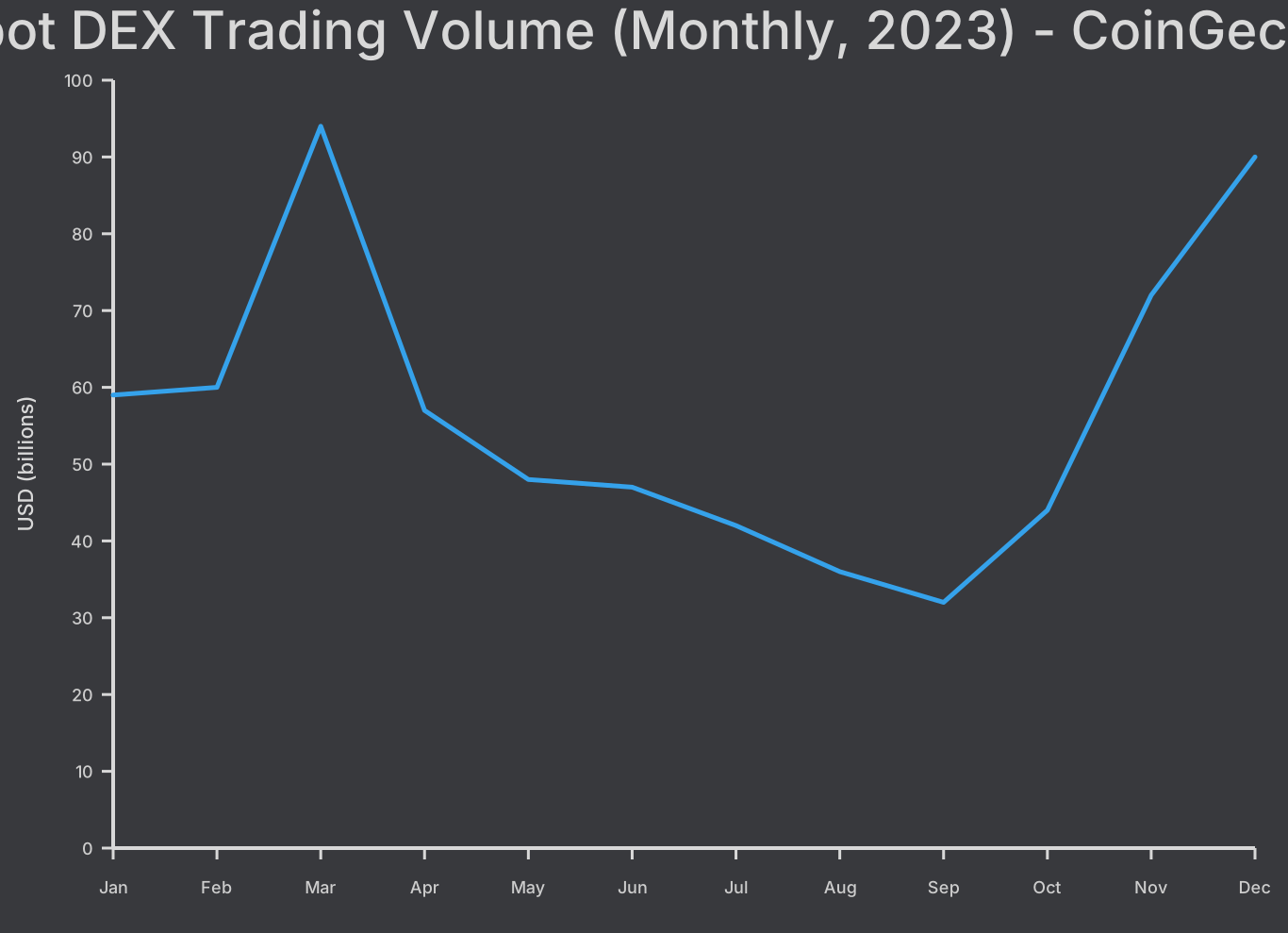
- 2023: monthly spot DEX totals (CoinGecko framing) imply roughly $681B annualized spot volume.
- 2024: top-10 spot DEX volume reported around $1.8T with strong YoY expansion.
- 2026 snapshot: approximately $9.558B (24h) and $378.685B (30d) spot DEX volume.
Illustrative chart: CoinGecko’s 2023 monthly spot DEX volume
DEX share vs CEX: what is measurable
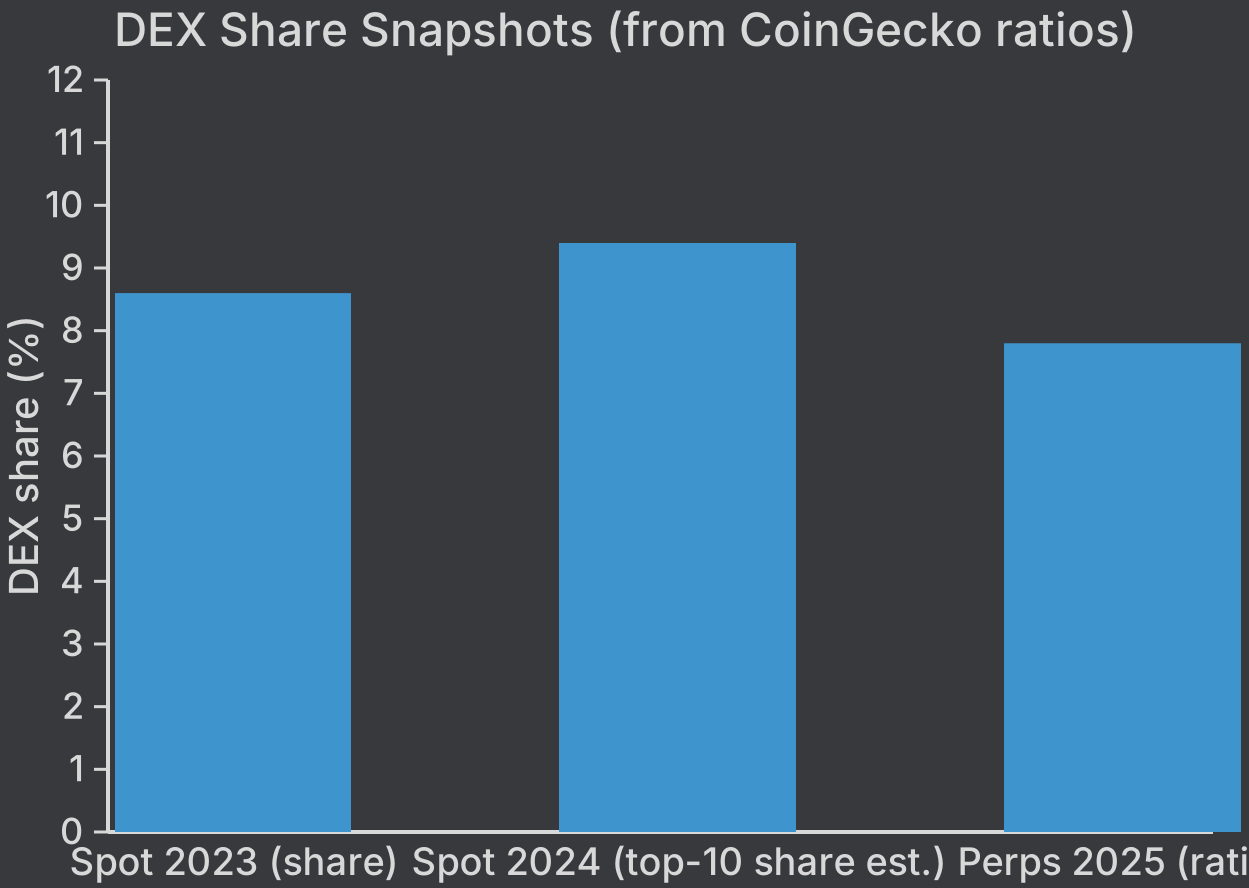
CoinGecko’s ratio framing implies spot DEX share around high single digits in 2023 and near ~9–10% for top-10 spot volume framing in 2024. In perpetuals, DEX share remains lower than spot but has grown materially, with 2025 ratio snapshots around high single digits.
Illustrative chart: DEX share snapshots (spot vs perps)
DEX TVL, fees, and revenue (snapshot)
TVL and volume measure different things. TVL reflects committed liquidity and risk capital. Volume reflects trading demand and routing intensity. High volume can coexist with lower TVL in highly efficient pool designs, while high TVL does not guarantee superior execution if liquidity is fragmented.
Representative protocol snapshot (Feb 12, 2026)
| Protocol | Primary model | TVL (approx) | Spot DEX volume (30d) | Perp volume (30d) |
|---|---|---|---|---|
| Uniswap v3 | Concentrated-liquidity AMM | — | ~$45.848B | — |
| Curve | Stable-swap AMM | ~$1.847B | ~$10.853B | — |
| PancakeSwap | AMM + multi-product | — | ~$42.876B | ~$560.73M |
| dYdX | App-chain order book | — | — | ~$10.619B |
| GMX | Perps AMM / pooled liquidity | ~$271.13M | ~$15.77M | ~$7.202B |
| THORChain | Cross-chain liquidity network | ~$64.53M | ~$1.089B | — |
| Raydium | Solana AMM | — | ~$10.553B | ~$405.15M |
| Orca | Solana AMM | ~$264.84M | ~$11.002B | — |
Comparability note: methodology and coverage differ by source page and product classification. Use cross-protocol comparisons directionally.
“Active addresses” and user-activity visibility
Some protocol dashboards provide active address and transaction metrics. For example, PancakeSwap snapshots show approximately 83,776 active addresses (24h) and 541,750 transactions (24h). This is useful for retail activity context, but not uniformly available for every protocol.
Liquidity depth: what can be said responsibly
Liquidity depth depends on market model. For AMMs it is usually measured as executable size inside a price-impact band. For order books it is top-of-book and ladder depth. Protocol-agnostic depth snapshots across all venues are still inconsistent, so depth should be treated carefully unless pool-level state is directly analyzed.
DEX design patterns and microstructure
Uniswap-style AMMs as continuous auctions
Constant-product AMMs can be interpreted as continuous auctions over a bonding curve. Arbitrage links AMM prices to broader markets. In concentrated-liquidity implementations, execution quality becomes more sensitive to position distribution and routing path.
Stable-swap AMMs as specialized liquidity engines
- Lower slippage for near-par assets.
- Efficient stablecoin liquidity aggregation.
- Different LP risk profile (including depeg and collateral cascade sensitivity).
Weighted AMMs: liquidity and portfolio mechanics
Weighted pools are often used for index-like exposure, liquidity bootstrapping, and governance-linked liquidity programs. Incentive design and vote-weight dynamics can materially shape market outcomes.
Order-book DEXs: latency, determinism, and composability trade-offs
On-chain order books maximize transparency but are throughput-sensitive. Off-chain matching plus on-chain settlement can improve matching speed and reduce some MEV exposure at the matching layer, while settlement-layer constraints still remain.
Price discovery and microstructure: DEX vs CEX
- Latency and sequencing: CEX internal engines are faster; on-chain settlement is block-time bounded.
- Transparency: DEX intents and liquidity state are often public before finalization.
- Fragmentation: liquidity is split across chains, pools, and fee tiers.
- Cost layering: trading fee + gas/sequencer + MEV slippage.
On-chain vs off-chain order books: simplified decision map
flowchart TD
  A[Choose DEX Market Design] --> B{Primary product?}
  B -->|Spot swaps| C{Asset types?}
  B -->|Perpetuals/derivatives| D{Need CEX-like latency?}
  C -->|Highly correlated (stable/stable)| E[Stable-swap AMM]
  C -->|Volatile/long-tail tokens| F[CPMM or Concentrated Liquidity AMM]
  D -->|Yes| G[Off-chain matching + on-chain settlement]
  D -->|No| H[On-chain CLOB or app-chain order book]
  F --> I{Chain fees/throughput constraints?}
  I -->|High fees / low throughput| J[Consider L2 or app-chain]
  I -->|Adequate throughput| K[Single-chain AMM + MEV protection]
Governance, tokenomics, and liquidity provision economics
Governance tokens and fee routing
Governance systems typically influence fee parameters, liquidity incentives, treasury allocation, and protocol upgrades. Fee-routing design can materially impact long-term liquidity quality and participant behavior.
The ve-model and long-term alignment
Vote-escrow models tie voting power to lock duration and can align governance influence with time commitment. In practice, this can improve incentive predictability but also concentrate influence if governance participation is uneven.
Incentive programs and “real yield”
Separating fees, protocol revenue, and incentive emissions is necessary for realistic sustainability analysis. High volume and high fees can still be subsidy-driven if emissions dominate net economics.
Impermanent loss and MEV as hidden cost centers
- LPs can be picked off when liquidity is stale during volatility.
- Sandwiching can worsen user execution and alter LP fee outcomes.
- Arbitrage is required for alignment, but value capture often accrues to searchers/builders rather than LPs.
AMM vs order-book: suitability matrix
| Dimension | AMM-based DEXs | Order-book / hybrid DEXs |
|---|---|---|
| Best suited for | Continuous swaps, long-tail assets, composable routing | Perpetuals, professional microstructure, precise limit orders |
| Capital efficiency | High with concentrated liquidity; lower in wide-range CPMM | Potentially high with strong maker participation |
| Execution quality drivers | Pool design, LP positioning, routing, MEV | Latency, matching fairness, maker competition, settlement costs |
| Primary risk surfaces | Contract/oracle math, sandwiching, LP adverse selection | Matching integrity, sequencer/validator assumptions, oracle + risk engine |
Security, common exploits, and case studies (2023–2026)
DEX security is layered: contract correctness, economic-game robustness, oracle integrity, bridge security, and key management. “Audited” is necessary but not sufficient for resilience.
Common exploit classes
- Smart-contract logic bugs (rounding, state-accounting, edge-case math).
- Oracle manipulation (price distortions propagating into lending/perps).
- Flash-loan amplified economic attacks.
- Bridge and cross-chain compromise.
- Governance/admin key misuse or compromise.
Case studies
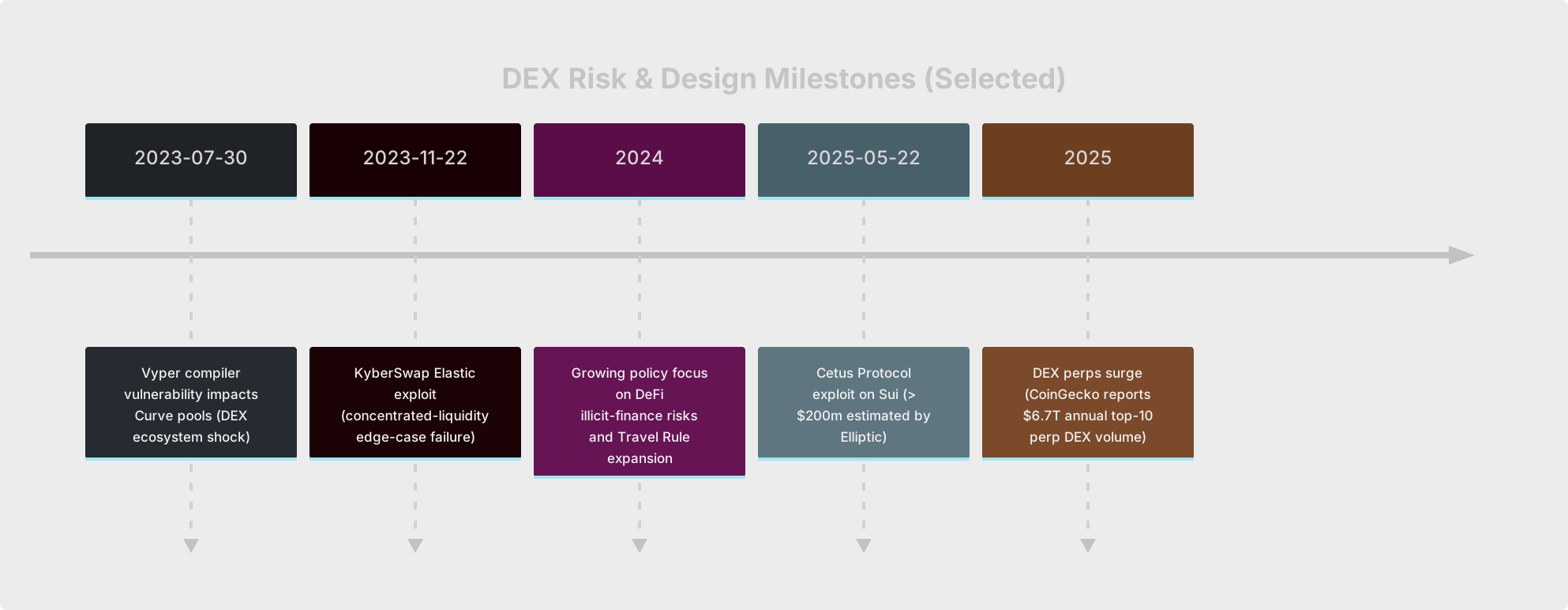
Curve / Vyper (Jul 30, 2023): compiler-level vulnerability impacted multiple pools and highlighted toolchain dependency risk.
KyberSwap Elastic (Nov 22, 2023): concentrated-liquidity edge-case and rounding issues drove significant losses.
Multichain + Orbit Chain bridge incidents (2023–2024): private-key and bridge-model failures reinforced bridge-perimeter risk.
Cetus Protocol (May 22, 2025): incident estimates exceeded $200M, showing maturity gaps in fast-growth ecosystems.
Balancer-related major exploit (2025): >$100M-class reporting emphasized persistent economic bug risk.
Threat model summary for DEX stakeholders
- Invariant-focused contract verification and adversarial simulation.
- Oracle resilience and manipulation windows.
- MEV-aware execution design (private flow, batching, anti-sandwich controls).
- Upgradeability governance and key management discipline.
- Bridge-specific controls for multi-chain deployments.
Macro security context (2025 datapoint)
Ecosystem-wide crypto theft estimates around $3.4B in 2025 and significant attributed nation-state activity underline that DEX and DeFi programs should assume advanced adversaries by default.
Regulation, compliance, tax/accounting, and practical guidance
Regulatory direction generally follows two tracks: activity-based (what service is being provided) and control-point (who controls interface, custody, fees, governance, and listing decisions).
AML/CFT and Travel Rule in practice
Policy focus is increasingly on whether DEX operators or connected service layers function as VASPs. FATF travel-rule adoption is growing but uneven across jurisdictions, creating enforcement and interoperability gaps.
EU direction under MiCA
MiCA focuses on service providers and issuance categories rather than autonomous protocol code in most interpretations. Hybrid DEX interfaces and custody/execution wrappers can fall in-scope depending on factual control.
Jurisdiction snapshots (trend overview)
- Singapore: stablecoin framework and tokenization focus.
- UAE (Dubai): comprehensive VARA framework evolution.
- Türkiye: travel-rule-aligned controls, delays/limits in certain transfer contexts.
- China: restrictive policy stance continues to shape access patterns.
Policy recommendations for regulators
- Regulate interfaces/intermediaries where practical control exists.
- Clarify “control and benefit” tests for DeFi/DEX classifications.
- Prioritize bridge and oracle security standards.
- Harmonize Travel Rule thresholds and message expectations.
Tax and accounting implications
This section is educational, not tax advice. Common treatment patterns include taxable disposal treatment for token swaps in many jurisdictions, expanding reporting frameworks, and evolving accounting treatment updates for digital assets.
- Tax: swaps and LP actions may trigger realization depending on jurisdictional rules.
- IFRS: holdings commonly analyzed under IAS 2 or IAS 38 depending on business model.
- U.S. GAAP: fair-value treatment updates materially affect reporting volatility in-scope assets.
Practical guidance by persona
For developers
- Select market model based on asset behavior and target participant profile.
- Test concentrated-liquidity edge cases and invariant boundaries aggressively.
- Treat oracle and bridge dependencies as first-class risk domains.
- Implement monitoring, kill-switch policy, and clear incident playbooks.
For LPs
- Evaluate expected fee income against volatility, IL exposure, and MEV drag.
- Prefer transparent governance, security posture, and admin-key policy.
- Account for cross-chain and wrapped-asset dependency risks.
For traders
- Use slippage limits consciously; tighter bounds reduce one risk while increasing revert risk.
- Prefer venues with explicit MEV mitigation tooling when execution size is meaningful.
- Treat custody hygiene as part of trading infrastructure, not an afterthought.
For compliance teams
- Model DEX exposure as a bundle of protocol, oracle, bridge, and sanctions risk.
- Align controls with Travel Rule and AML obligations where applicable.
- Deploy transaction monitoring and address-risk scoring for on-chain interactions.
Future outlook: scenarios for the next 5–15 years
L2-native and app-chain growth: lower latency/cost execution with periodic base-layer settlement should continue to expand.
MEV-aware market design: batch auctions, intents, private order-flow channels, and protocol-level guardrails are likely to become default in high-volume venues.
Cross-chain consolidation: demand for multi-chain liquidity will persist, but successful systems will increasingly prioritize defense-in-depth and operational security discipline.
Mini timeline of notable DEX/security milestones (illustrative)